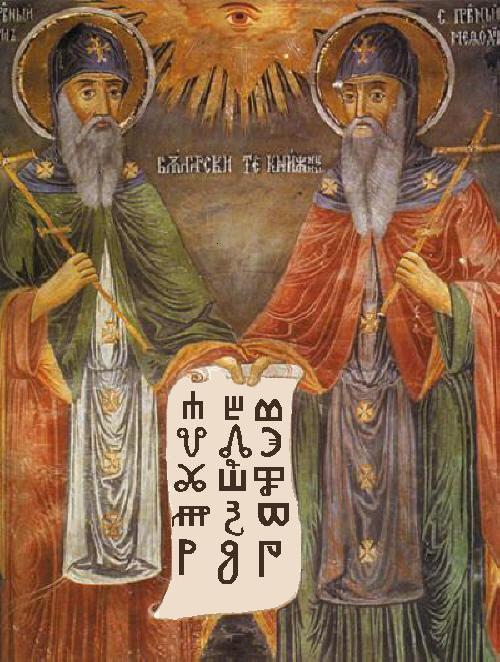
Bulgaria is among the few nations worldwide having their special day of culture, which is celebrated every year on May 24th – the Day of the Slavonic Alphabet and Bulgarian Culture. That holiday is expression of the pride felt by Bulgarians and coming from the fact that only they have accepted Cyril and Methodius' disciples and created for them everithing they needed to disseminate their creation (the Cyrilic alphabet) as well as creating the first cultural and enlightment centres in the Slavonic world.
Cyrilic alphabet which is the third official alphabet in Europe, was created by two brothers of Bulgarian origin - Cyril and Methodius. They were promulgated in 1980 for co-patrons of Europe by late pope John Paul the Second along with St.Benedict. The two brothers who are often called Slavonic apostles are from Bulgarian origin (they were born in Thessaloniki and their mother was Bulgarian). Cyril and Methodius start their activity as a christian misionaries from Bizantium. During their third mission, in Moravia, they come to conclusion that it is impossible to preach on greek or latin to people who do not understand these languages. That is the time when Cyril creates the first version of of the alphabet called glagolitsa and with the help of his brother continues his mission, to show the elite in all Slavonic states his alphabet and its great significance for Slavonic people, giving them opportunity to write with their own letters, to translate the Holy books and make them understandable to all and last but not least to create their own texts and literature on their own language.
The celebrations on 24th of may are expression of the pride about the fact that all people who ever lived on Bulgarian lands - Thracians, proto-Bulgarians, Slavs – have left their imprint in the world cultural heritage.
The Thracians and their ancestors left unique works of art representing the material and spiritual culture in hundreds of thracian tombs found on these lands. The Varna Necropolis dating from 4600 - 4200 B.C. that preserved the oldest processed gold ever, the Thracian tombs and sanctuaries in Kazanlak, Sveshtari, Starosel and Aleksandrovo are famous all over the world. There are numerous Greek, Roman and Byzantine monuments from the Antiquity and the Early Middle Ages. Bulgarians inherited that high level culture, enriched it with their thousand-year experience, and preserved and developed it until present days.
There are eight sites on the Bulgarian territory recognized as unique, with world significance and included in the UNESCO List of the Cultural and Natural Heritage.
The folk art has preserved the freshness of the public customs and songs and the folk crafts until present days. The Bulgarian folk song „Izlel e Delyo Haydutin”, sung by Valya Balkanska, was selected to be the musical message of the Earth to the far Cosmos and since 1977 it has been travelling on the board of Voyager 1.
Nowadays the Bulgarian culture is proud of its achievements in the field of literature, arts, music, architecture and sports. The world famous artist Jules Pascin who is one of the most prominent figures in the artistic circle of Montparnasse in the beginning of 20th century, was of Bulgarian origin; also the painter Georges Papazoff, an emblematic figure in the surrealism; Nikola Manev – a master of the abstract painting. Works of one of the most admired Bulgarian painters – Vladimir Dimitrov – the Master, that preserved the soul of the old masters and Zlatyu Boyadzhiev, considered the most distinctive Bulgarian painter of 20th century, have been exposed in Budapest, Vienna, Rome, Paris and USA. The Bulgarian artist Christo Javasheff, famous all over the world as Christo, is one of the greatest avant-garde artists of our times, the creator of the wrapping as an artistic technique, who wrapped the Pont-Neuf bridge in Paris, the Reichstag in Berlin, the author of the project The Gates in Central Park, the Umbrellas in Japan and California.
By his work the composer Pancho Vladigerov was the first who won international recognition and prestige for the Bulgarian music and cleared the way for the big stage. In the operatic art Bulgaria has contributed with well-known names like Boris Hristov, Nikola Gyaurov and Nikola Gyuzelev - great bass opera singers, phenomenon in the operatic art, Rayna Kabaivanska - one of the most significant soprano voices during the second half of 20th century, for whom Luciano Pavarotti said: „Toska of the past is Maria Callas, Toska of today is Rayna Kabaivanska”. The voice of Gena Dimitrova is also world famous and she is the first foreign singer who was invited three times to open the season of La Scala. Karajan said about her: „I lived to hear a voice, which only gods deserve.” We cannot talk about music and miss the names of the big music director Emil Chakarov, the two great violin players Mincho Minchev and Vasko Vasilev, the famous clarinet player Ivo Papazov and the great jazzman Milcho Leviev.
The Bulgarian humanistic values have been confirmed abroad thanks to the translated works of Bulgarian authors, among which Ivan Vazov – the patriarch of the Bulgarian literature, Hristo Botev, Yordan Yovkov, Pencho Slaveikov, Peyo Yavorov, Emilian Stanev, Nikolay Haitov, Yordan Radichkov. Furthermore it would be appropriate to mention the names of three more great authors, that were born in Bulgaria: Elias Canetti (born in Ruse) novelist and non-fiction writer, who wrote in german and won Nobel Prize in Literature in 1981. Julia Kristeva (born in Sliven) is a Bulgarian philosopher , literary critic , psychoanalyst and sociologist, and Tzvetan Todorov (born in Sofia ) a philosopher, historian and writer.
Bulgarians have great achievements in science, too. Probably many of you will be surprised to learn that the father of the computer is also Bulgarian - this is John Atanasov - the inventor of the first digital electronic computer.
The achievements of the Bulgarian sportspersons are also worth mentioning. The high jump record of 209 cm of the Bulgarian high jumper Stefka Kostadinova is still unbroken and her bar decorates the entrance of the Olympic Museum in Lausanne. Bulgaria has world fame also for its football talents. The name of Hristo Stoichkov who won the Golden Ball in 1994 and the name of Berbatov are well known to football fans. In chess Bulgaria is proud of one of the greatest chess players of our times - Veselin Topalov.
The cultural heritage of Bulgaria and its scientific and artistical achievements allows the country to take its befitting place in the European cutural space.
Bulgaria is among the few nations worldwide having their special day of culture, which is celebrated every year on May 24th – the Day of the Slavonic Alphabet and Bulgarian Culture. That holiday is expression of the pride felt by Bulgarians and coming from the fact that only they have accepted Cyril and Methodius' disciples and created for them everithing they needed to disseminate their creation (the Cyrilic alphabet) as well as creating the first cultural and enlightment centres in the Slavonic world.
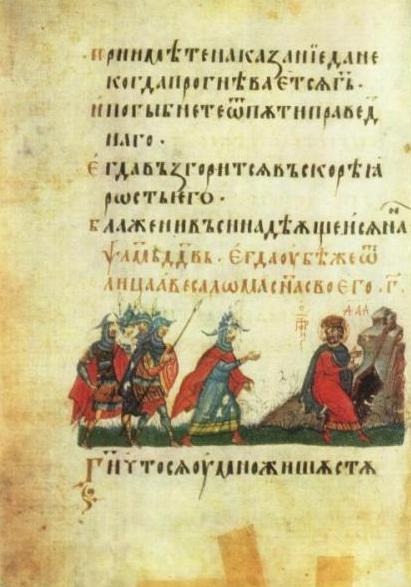
Cyrilic alphabet which is the third official alphabet in Europe, was created by two brothers of Bulgarian origin - Cyril and Methodius. They were promulgated in 1980 for co-patrons of Europe by late pope John Paul the Second along with St.Benedict. The two brothers who are often called Slavonic apostles are from Bulgarian origin (they were born in Thessaloniki and their mother was Bulgarian). Cyril and Methodius start their activity as a christian misionaries from Bizantium. During their third mission, in Moravia, they come to conclusion that it is impossible to preach on greek or latin to people who do not understand these languages. That is the time when Cyril creates the first version of of the alphabet called glagolitsa and with the help of his brother continues his mission, to show the elite in all Slavonic states his alphabet and its great significance for Slavonic people, giving them opportunity to write with their own letters, to translate the Holy books and make them understandable to all and last but not least to create their own texts and literature on their own language. Moravian mission becomes cornerstone for the work of the two brothers. After being persecuted by the german clergymen in Moravia, finally Cyril and Methodius won brilliant victory over their malignant persecutors by being allowed to preach on Slavonic language and receiving the blessings from the pope Adrian the Second. After the unexpected death of Cyril in Rome in 869, Methodius went to Panonia (today's Croatia) and finally went back to Moravia where he was promulgated for bishop. During their missions, Cyril and Methodius trained several disciples who followed them in their journeys and worked together with them. After Methodius' death in 885 and the coming of a new pope - Stefan the Second, all the followers of the Holy brothers once again were subject of persecution, torture and imprisonment all in attempt to make them renounce their work. Some of them were sold as slaves in Venice. Then after numerous mishaps finally, few of the disciples (Kliment, Naum, Angelariy and Sava) managed to reach Bulgaria, where they have been given warm welcome by kniaz Boris the First. Kniaz Boris the First was wise and well educated man who understood very well the great significance of the Slav alphabet for keeping Bulgarian state and church independent from Bizantine and Roman influence, and created all necessary conditions for the dissemination of the alphabet, the translation of Holy texts, the forming of an intelectual elite and the creation of original Bulgarian literature. That wise ruler then desided to create two big enlightment centers, which were to serve for education of clergymen and general cultural activities - the first led by Naum was to be created in the capital Pliska and the second led by Kliment in a south-western province with capital city Ohrid (today's Republic of Macedonia). After the ascending on the throne of tsar Simeon in 893, the capital is moved to Preslav and all spiritual and cultural activities are concentrated there. In the meantime one of the disciples , Konstantine, who was earlier sold in slavery in Venice, was rebought again and came back to work with his fellow-disciples in Preslav. During the reign of tsar Simeon, both literary centres - in Preslav and Ohrid flourished, Cyril and Methodius' followers train their own disciples who in their turn translate and rewrite the Holy texts on bulgarian and with starting to create their own texts, they turned actually in the first ever bulgarian authors, and even the first Slavonic authors. Kliment Ohridski creates the new version of the alphabet, which is in use until now and is called "Cyrillic alphabet" in honour of St. Cyril. Kliment Ohridski, Konstantin Preslavski, Naum were not only teachers and propagators of the alphabet, but are creators too - writers and translators, who left for the generations priceless heritage. That is how by accepting Cyril and Methodius' disciples, Bulgaria becomes the first cultural and spiritual centre in the Slavonic part of Europe. The deep gratitude of Bulgarians for the work of the Holy brothers finds expression on 24th of may - one of the prettiest and most moving Bulgarian holdays. Celebrations are organized in every school, official parades and ceremonial processions take place in towns and villages alike, people carry the iconic images of the two brothers and their followers (because they have all been canonized by the Orthodox church); this is the day, in which medals and awards are given to the Honoured intellectuals - writers, poets, artists, scluptors, musicians, actors, scientists etc. Each year on 24 th of may official Bulgarian delegation goes to Rome, in the basillica "St. Climent", to pay respects to the grave of St.Cyril and honour the memory of the Holy brothers and their disciples.

 en
en fr
fr de
de BG
BG